Yizhuo Tan

Yizhuo Tan

PhD Candidate

Yale University

Hi! I’m Yizhuo, a fourth-year Ph.D. student in Computer Science at Yale University, advised by Prof. Jakub Szefer (Northwestern University) and Prof. Yongshan Ding.

My research aims to enable reliable, scalable, and efficient quantum computation. I study how physical device properties, qubit interactions, and hardware constraints shape quantum system design. I examine how physical errors affect computational behavior and performance at both the circuit and logical levels, with particular interest in quantum error correction. I also investigate reliability, security, and privacy challenges, including unwanted interference and information leakage, and explore methods for protecting quantum computations and data.

Thanks for visiting my website! Feel free to reach out if you’d like to exchange ideas, ask a question, or just say hello.

I am currently seeking internship and research visit opportunities for Summer 2027.

Interests
  • Quantum Computer Architecture and Systems
  • Quantum Error Correction
  • Quantum Computing Reliability, Security, and Privacy
Education
  • PhD in Computer Science, 2028 (Expected)

    Yale University

    September 2023 – Present

  • B.Sc. in Physics, 2023

    University of Science and Technology of China (USTC)

    September 2019 – July 2023

    Atomic and Molecular Physics track
    Minor in Computer Science and Technology

Experience


Yale University
Doctoral Research / Research Assistant
September 2023 – Present


Northwestern University
Research Visit
July 2026 – September 2026


University of Science and Technology of China (USTC)
Undergraduate Research Assistant
September 2021 – March 2022


University of Science and Technology of China (USTC)
Undergraduate Experimental Project
September 2021 – December 2021
First Prize, 17th Physical Innovation Research Experimental Paper Competition, USTC (2021).

Selected Research

Logical Operation Identification in qLDPC Codes

I study what syndrome histories reveal about logical operations in qLDPC codes. I developed likelihood-based inference using exact fault marginalization and scalable approximations to identify logical instructions and circuits while reducing computation and memory costs. I also analyzed identification limits and evaluated refinements for cases with low identification accuracy.

Manuscript · 2026

Superconducting Processor Modeling and Reliability (EPAR)

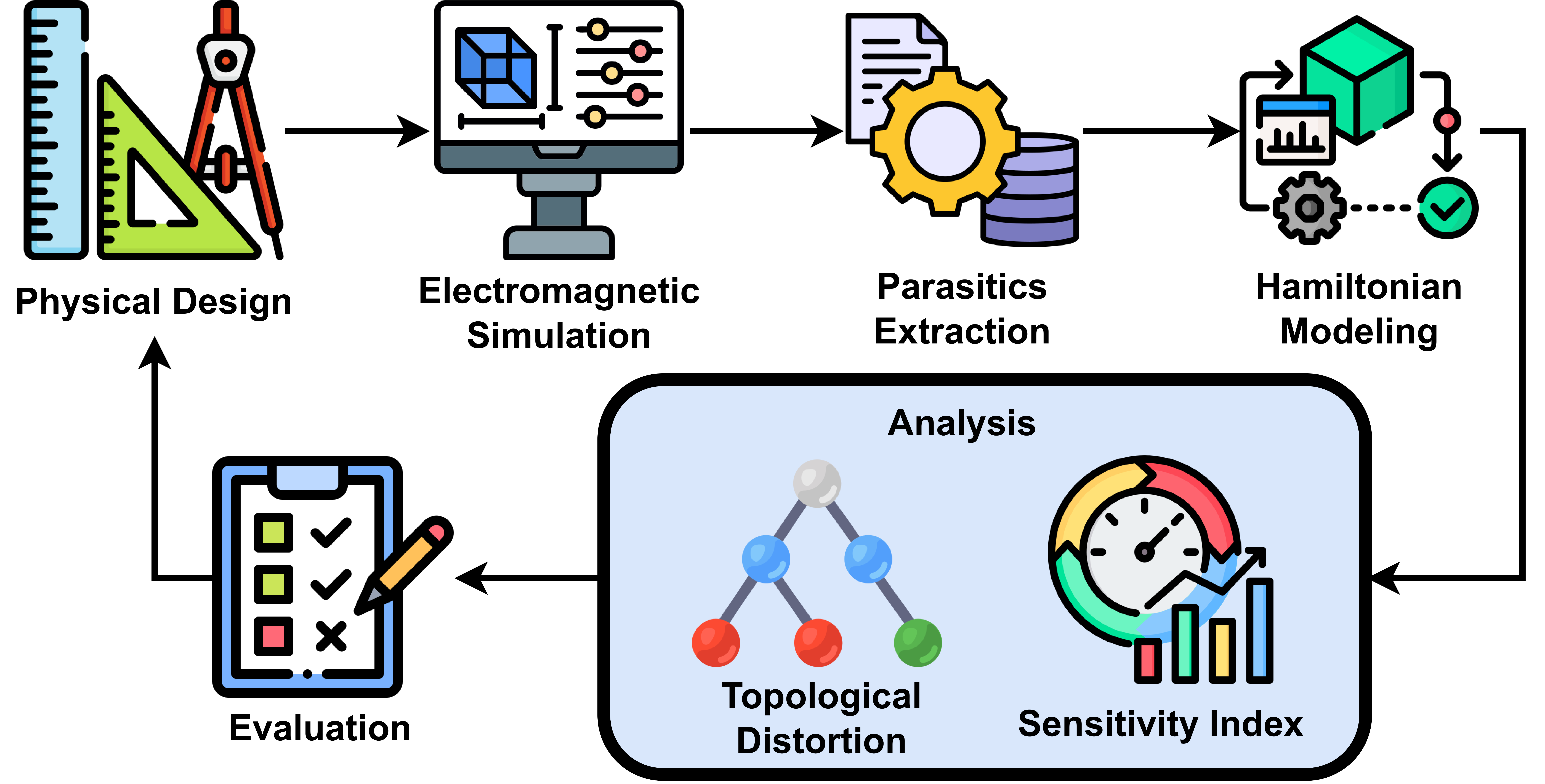
EPAR predicts how physical layout affects the robustness of superconducting quantum processors by connecting electromagnetic modeling, effective Hamiltonians, and control-pulse response. I co-developed the framework and constructed superconducting circuit models and chip layouts from target Hamiltonians, including layout implementation in Qiskit Metal. The framework quantifies deviations between intended and effective qubit connectivity and the sensitivity of parasitic couplings to local parameter variations.

EPAR workflow connecting physical layout, electromagnetic simulation, effective Hamiltonians, and reliability evaluation.
EPAR workflow · Fig. 1Click image to enlarge

Private Delegated Quantum Queries (OQRAM)

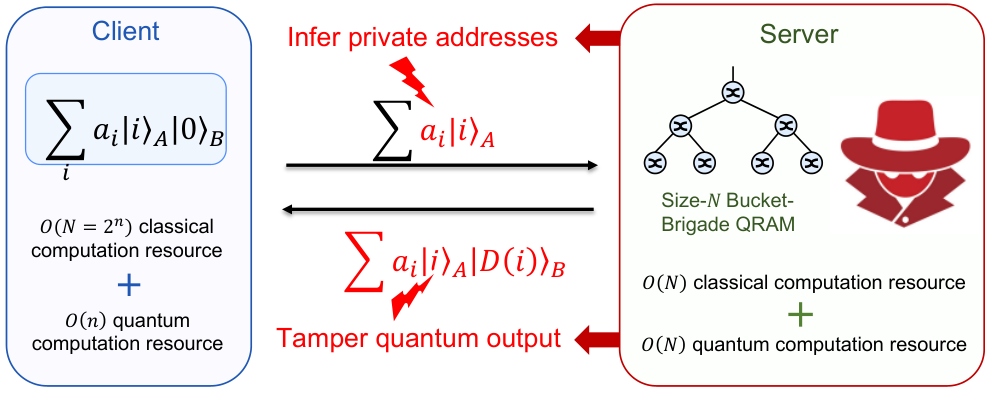
OQRAM protects delegated coherent quantum queries for clients with limited quantum resources. I co-designed protocols using encrypted and shuffled database layouts with quantum-secure address masking, and co-developed their security and resource analyses. These analyses establish online quantum communication linear in the combined address and ciphertext register widths and quantify classical database refresh costs.

arXiv preprint · 2026 · Equal contribution

OQRAM system model showing a resource-limited client delegating quantum queries to a server and the privacy and integrity threats.
OQRAM system model · Fig. 2Click image to enlarge

Quantum Hardware Reliability and Security

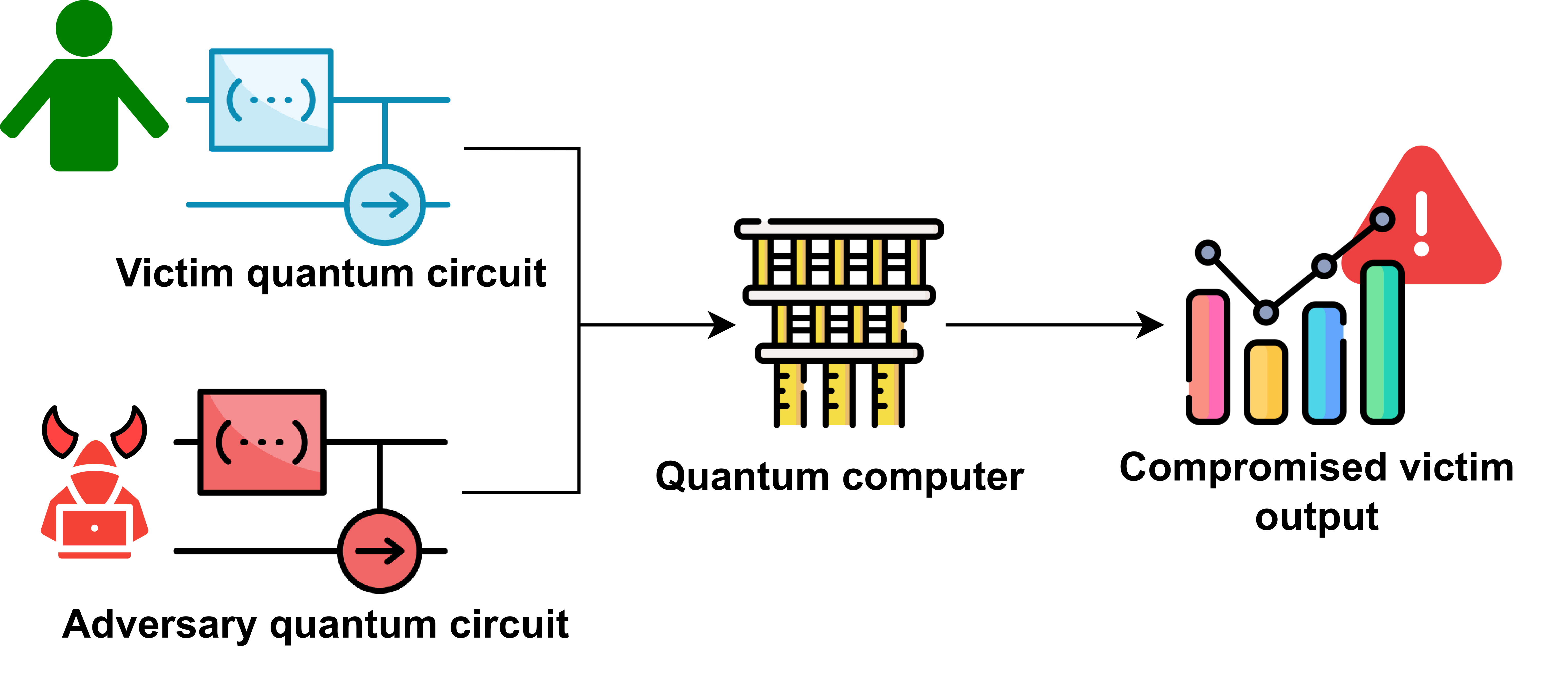
I investigate how unwanted interactions between superconducting qubits affect workload isolation and leak information. In QubitHammer, I designed and validated pulse-level attacks on IBM and Rigetti processors and implemented Rigetti experiment workflows in Python with Amazon Braket for calibration retrieval, hardware execution, and measurement analysis. In separate readout-crosstalk work, I characterized correlations between measurement outcomes to quantify crosstalk and information leakage.

QubitHammer · HOST 2026

Readout crosstalk · QSec@CCS 2025 Best Paper Award

QubitHammer threat model showing victim and adversarial circuits running on shared quantum hardware.
QubitHammer shared-hardware model · Fig. 1(a)Click image to enlarge

Teaching

Publications

See the complete publication list, including peer-reviewed papers and preprints.
(2026). Identifying Logical Operations from Syndrome Histories for qLDPC Codes. Manuscript.
(2026). OQRAM: Oblivious Quantum Random Access Memory for Securing Delegated Quantum Queries. arXiv preprint, arXiv:2607.27171.
* Equal contribution.
(2026). EPAR: Electromagnetic Pathways to Architectural Reliability in Quantum Processors. DAC 2026.
(2026). QubitHammer: Remotely Inducing Qubit State Change on Superconducting Quantum Computers. HOST 2026.
(2025). Securing HHL Quantum Algorithm against Quantum Computer Attacks. HASP@MICRO 2025.

Awards

Silver Award of Excellent Student Scholarship (Top 2%)
1st Place in 17th Physical Innovation Research Experimental Paper Competition
Second Prize in 6th China Undergraduate Physics Experiment Competition (CUPEC)
Provincial First Prize in 35th Chinese Physics Olympiad (CPhO)

Beyond Research

Meet Beau
Volunteer
Basic Life Support (BLS) Provider

Contact

  • yizhuo.tan@yale.edu
  • 51 Prospect Street, New Haven, CT 06511
  • 5th Floor, Arthur K. Watson Hall (AKW), Yale University